Why does distance matter so much to gravity?
Move twice as far away and the pull does not halve — it drops to a quarter. That one detail decides how orbits, tides and falling all behave.
5 min read
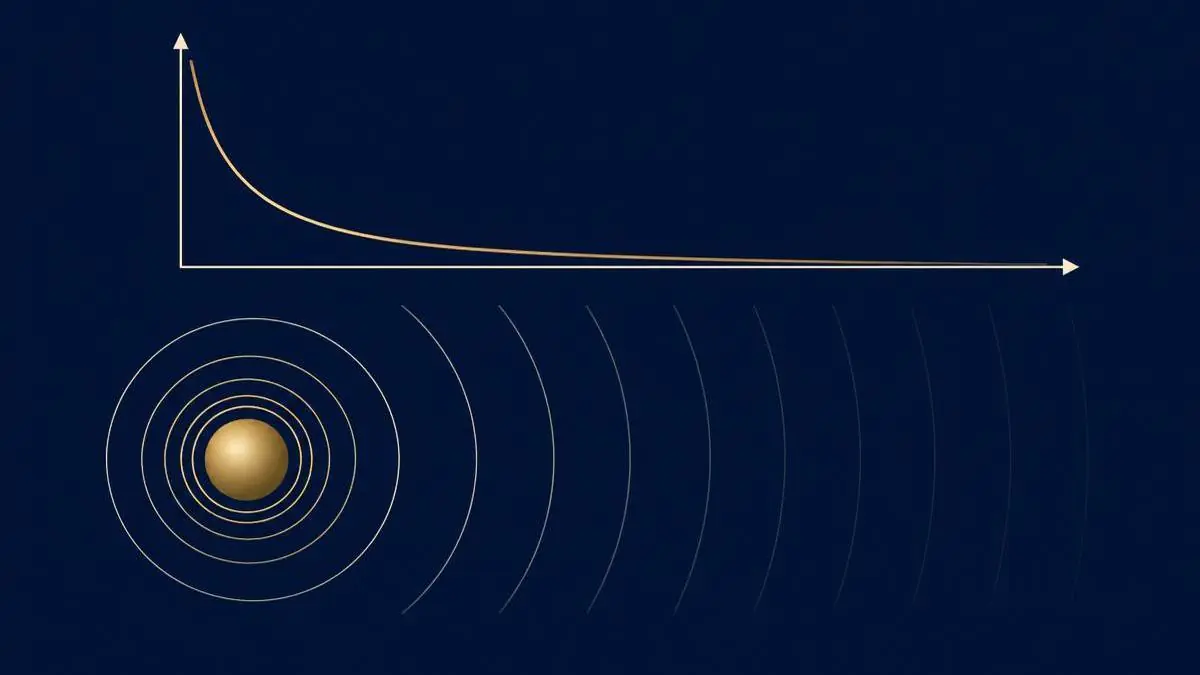
Stand on a bathroom scale. Now imagine climbing to the top of a tall building and taking the scale with you. You are further from the centre of the Earth than you were, so the pull on you is weaker, so the number should be smaller.
It is smaller. It is also so slightly smaller that the scale will never notice. Go up 400 kilometres instead, to the height of the space station, and the pull is about a tenth weaker — still nothing like zero. Go out to the Moon's distance and the Earth's pull on you has dropped to roughly a three-thousandth of what it is here.
That is a strange pattern. Small movements do almost nothing. Big movements do an enormous amount. Understanding why is one of the most useful things you can carry around in your head.
The rule behind the pattern
Gravity gets weaker with distance in a very particular way. It is not "twice as far, half as strong". It is "twice as far, a quarter as strong". Three times as far, a ninth. Ten times as far, a hundredth.
You square the distance and the pull divides by that. Physicists call it an inverse square law, which sounds forbidding and means only this: distance counts twice.
Here is a way to feel why. Picture the pull spreading out from a planet in every direction at once, like light from a bare bulb in the middle of a dark room. Hold a sheet of paper near the bulb and it catches a bright patch of light. Walk backwards and the same amount of light is now spread over a much wider area, so your sheet catches less of it. The light is not being used up. It is being thinned out over a bigger and bigger surface.
The surface that light or gravity spreads across is a sphere, and the area of a sphere grows with the square of its radius. Double the radius and you have four times as much surface to cover. So each patch gets a quarter as much. The squaring is not an extra rule bolted on. It is just geometry, running in three dimensions.
Why the top of a building changes nothing
The rule only pays attention to distance from the centre, and that is the part almost everyone gets wrong first.
You are not 2 metres from the Earth. You are about 6,371 kilometres from its centre, because that is where all of the planet's pull effectively acts from. Climb a 200-metre building and your distance goes from 6,371 to 6,371.2 kilometres. That is a change of three-thousandths of one per cent. Square it, invert it, and the difference in your weight is far too small to see on any bathroom scale.
This is why "further away" feels so unhelpful in ordinary life. On the surface of a planet you cannot get meaningfully further away. You are already sitting on top of a very large radius, and everything you can climb is a rounding error on it.
Space is different because space is measured in whole planet-widths. Getting one Earth-radius above the surface — 6,371 kilometres up — genuinely doubles your distance from the centre, and there the pull really is a quarter of what it is at your feet.
What the rule buys you
Once you trust the squaring, a lot of unrelated-looking things stop being mysterious.
Orbits. The space station is not beyond the Earth's pull. At its height the pull is about 90 per cent of surface strength. Astronauts float because they are falling, continuously, and moving sideways fast enough that the ground keeps curving away beneath them. Weightlessness up there is about falling, not about distance.
Tides. The Moon pulls the near side of the Earth slightly harder than the far side, simply because the near side is closer. The difference is tiny, but oceans are free to move, and a tiny sustained difference applied to a whole ocean is a tide. Tides exist because gravity changes across a distance rather than acting evenly.
Why the Sun beats the Moon and still loses. The Sun is vastly more massive than the Moon, which pulls the Earth far harder overall. But it is also enormously further away, and the difference in its pull from one side of the Earth to the other is smaller than the Moon's. So the Sun wins on raw pull and the Moon wins on tides.
Why gravity never switches off. Dividing by a bigger and bigger number gets you closer and closer to zero without ever arriving. There is no distance at which gravity stops. Every mass in the universe is pulling on you right now, almost all of it so faintly that it will never matter to anything you do.
The part worth remembering
Two things, and they pull in opposite directions.
Gravity fades fast — fast enough that doubling your distance costs you three quarters of the pull. And gravity never quite ends — no matter how far you go, there is always some left.
Both are the same rule seen from different ends. Nothing about it depends on how heavy you are or which way up you are standing. It depends on one number: how far you are from the centre of the thing pulling on you. Change that number and you have changed what falling means.
In the book