Why would you be weightless at the centre of the Earth?
The middle of a planet sounds like the strongest place for gravity. It is actually the one place with none at all.
4 min read
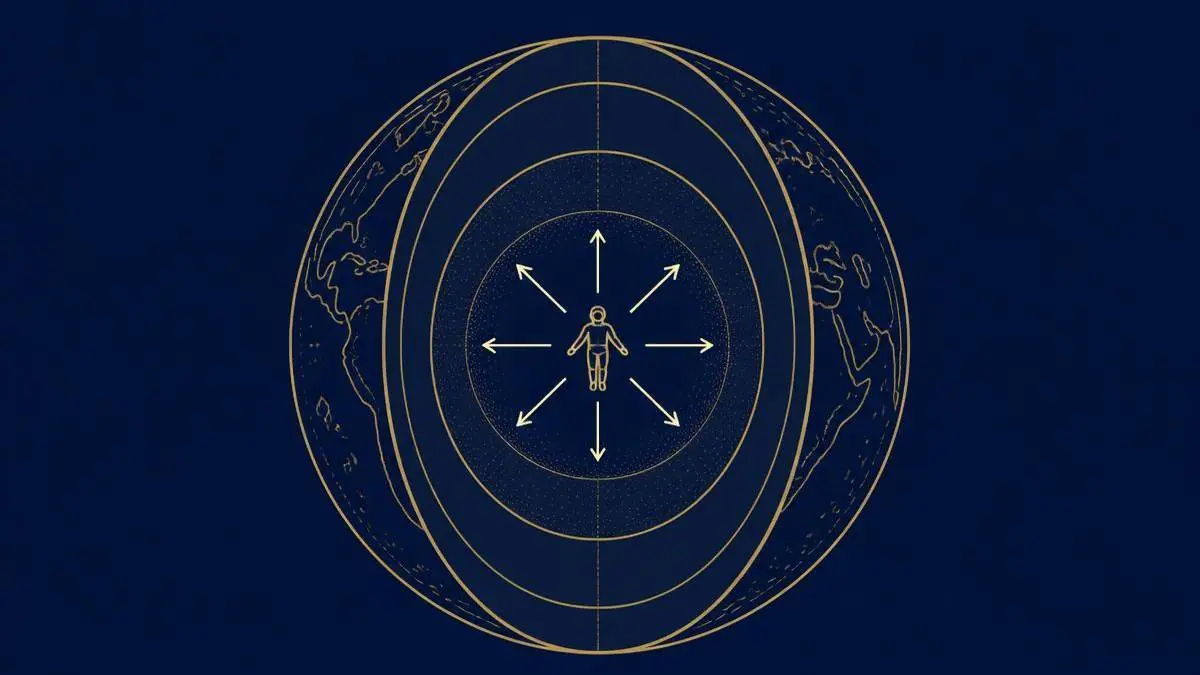
Ask where the Earth's gravity is strongest and almost everyone answers the same way: the middle. It is where all the mass is heading, it is the deepest you can go, it is the place everything falls towards. It ought to be the crushing heart of the whole business.
It is the opposite. If you could stand at the exact centre of the Earth — ignore the heat, ignore the pressure, we are doing physics, not survival — you would be perfectly weightless. Not slightly lighter. Weightless, like an astronaut, with no up and no down and nothing pulling you anywhere at all.
Nothing is switched off to make that happen. Every atom of the planet is still pulling on you as hard as it ever was.
Pulled from every direction at once
Standing on the surface, every part of the Earth is beneath you in some direction or other. Ground under your feet, rock beneath that, iron below that — all of it on the same side of you. The pulls point every which way, but they all have some downward in them, and added together they make one firm pull towards the centre.
Now move yourself to the centre. The planet has not gone anywhere; it has rearranged itself around you. There is rock beneath your feet and just as much rock above your head. There is the same amount to your left as to your right, the same in front as behind. You are in the middle of a complete shell of mass, and every pull you feel has an exact twin pointing the opposite way.
Add them up and you get zero. Not because the pulls are weak, but because they are perfectly balanced. A tug-of-war with identical teams on every side of the rope is still a tug-of-war; the rope simply does not move.
That is all weightlessness ever means, by the way. Not the absence of gravity — the absence of anything left over once everything has been added up.
The rule that makes it exact
The reason it cancels perfectly, rather than just roughly, is a result Isaac Newton proved and then found so pleasing that he built much of his gravity work on it.
Imagine a hollow ball of uniform material — a shell. If you stand anywhere inside that shell, the shell's pull on you is exactly nothing, no matter where inside it you are. Stand right up against the inner wall, with a thin sliver of shell centimetres away on one side and the entire rest of it far away on the other, and it still cancels. The near material pulls hard but there is very little of it. The far material pulls weakly but there is enormously more of it. The two effects trade off precisely.
Treat the Earth as a stack of shells, one inside the next like the layers of an onion. Wherever you stand, every shell above you contributes nothing, and only the ball of material below you pulls at all.
At the surface, that means the whole planet counts. Halfway down, only the inner half counts, and you are closer to it — so the pull drops, but not as fast as you might guess. At the very centre there is no material below you at all, so there is nothing left to do any pulling.
So where is gravity strongest?
Right where you are sitting: the surface. That is the sweet spot.
Go up, and the pull thins out with distance. Go down, and you start leaving mass behind you, above your head, where it no longer counts. Either direction from the surface makes you lighter. The strongest gravity on Earth is at your feet, which is a genuinely odd thing to know about the place you live.
Digging down does not weaken it as sharply as most people expect, because the Earth is not evenly packed. The dense iron core is concentrated near the middle, so the pull holds up surprisingly well for the first couple of thousand kilometres of depth — it actually creeps slightly higher before turning around and heading for zero.
What falling through would look like
Suppose there were a tunnel straight through the planet and you jumped in.
You would fall, gaining speed the whole way down, but gaining it less and less urgently as the pull faded. You would flash through the centre at your top speed — many kilometres per second — completely weightless for that instant, and then begin to slow, because now the mass is behind you and the pull is against you.
You would rise until you were just level with the far opening, stop for a moment, and fall straight back. Forever, in a frictionless tunnel: down, through, up, back, like a pendulum with the whole planet as its pivot. The trip end to end would take about 42 minutes, which is a wonderfully specific number for something so impossible.
Nowhere in that journey does gravity turn off. The pull is doing exactly what it always does. It is just that at one point on the route, everything pulling on you is pulling equally in all directions — and equal pulls in all directions is indistinguishable from no pull at all.
In the book