Could Drop actually work?
A sport played on ground that will not hold still, where every push you give is a push you get back. Most of it is real. One part is not.
5 min read
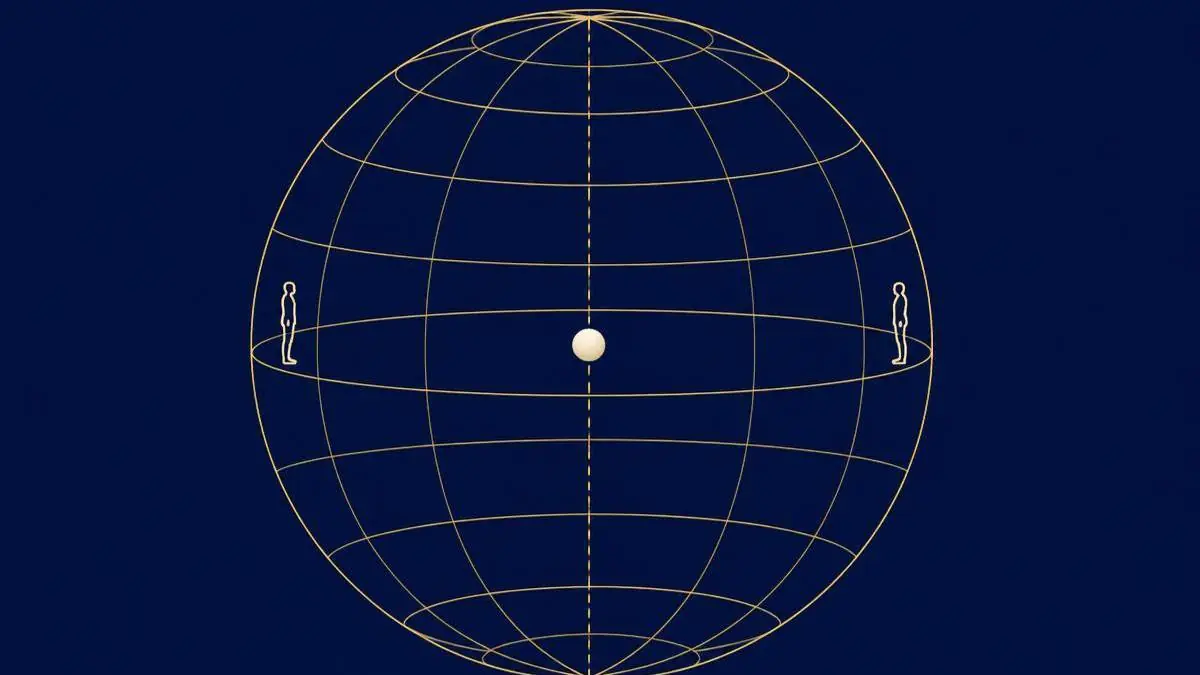
Drop is played on ground that will not hold still. There is no way to move something without being moved by it, and no way to hide how hard you pushed.
That is a made-up sport in a made-up place. But it is built out of real rules, and the interesting question is not whether the setting exists. It is whether the play would work — whether a person following those constraints could do anything worth watching.
Mostly, yes. Let us take it apart.
The part that is completely real
"There is no way to move something without being moved by it" is not an invented rule. It is Newton's third law, stated the way a coach would state it instead of the way a textbook does.
Push a wall and the wall pushes back on your hands exactly as hard. Push a friend on ice skates and you both slide away from each other. The push is never one-directional; forces come in pairs, always equal, always opposite, with no exceptions anyone has ever found.
On solid ground you do not notice, because the thing you are pushing is a planet. Your shove goes into the Earth and the Earth's answering shove goes into you, and since it is the size of the Earth, you are the only one who visibly moves. Take away the planet-sized partner — put players on ground that is itself falling, and give them mostly each other to push against — and the pairing becomes the entire game. Every move costs you the mirror image of itself.
Cosmonauts and astronauts live inside this. Push off a wall in orbit and you cross the module; there is no way to stop mid-air, no way to turn without something to turn against. They train for months to move well under exactly the constraint Drop is built on.
The part that is real but counter-intuitive
"Falling ground" sounds like the players are helpless. They are not, and this is where the sport gets clever rather than chaotic.
If you and the floor are falling together at the same rate, you do not feel yourself falling relative to the floor. You feel weightless, and the floor might as well be still. That is exactly the situation on the space station: everything is falling, the whole thing is in free fall together, so nothing inside it appears to fall at all.
So a player on falling ground is not being flung about. They are floating with respect to their pitch. What matters is not the fall — it is any _difference_ between how you are falling and how the ground under you is falling. Change your motion, even slightly, and the ground starts sliding past you. Get it right and you can steer.
That is a game. It is also nearly a real training discipline.
The part that is a genuinely good rule
"No way to hide how hard you pushed" is the sharpest thing in the design, because it is true and most sports are not like this.
A footballer can disguise effort. A swimmer's stroke wastes some of itself in churned water; you cannot read the exact force from the result. But when your only purchase is a push against another body, the outcome is arithmetic. Momentum is conserved: whatever you sent one way, you went the other way with the matching amount. An opponent watching how far you drifted knows precisely what you spent.
You could referee that sport with a stopwatch and honest measurement. Nobody could argue with the reading. That is a rule with real teeth, and it comes free with the physics rather than being imposed by a rulebook.
Where it stops being possible
Two places.
A pitch that stays in free fall. On Earth, anything falling reaches the ground in seconds. To fall continuously you have to be in orbit, which means moving sideways at roughly 28,000 kilometres per hour so the planet's surface keeps curving away beneath you. Free fall is not hard to arrange; free fall you can _stay_ in is enormously hard. Aircraft flying long parabolic arcs give researchers about twenty seconds at a time, which is a drill, not a match.
Stopping. This is the honest problem. If your only way to change speed is to push off something, then every stop costs you another push and gives whatever you pushed a shove in return. There is no braking, only trading. A real Drop pitch would need boundaries, tethers or a floor to absorb momentum somewhere, or a game would end with every player drifting in a different direction and nothing left to push against.
The verdict
The rules are sound. Newton's third law, conserved momentum, and the weightlessness of shared free fall are all exactly as described, and the tactics that fall out of them — push economy, reading an opponent's spend, never wasting a shove you cannot get back — would genuinely decide matches.
What is invented is not the physics. It is the venue: ground that keeps falling and never lands. Grant that one thing and everything else follows honestly, which is a very good trade for a story to make.
In the book