Do you actually move the Earth when you jump?
You push the planet exactly as hard as it pushes you. The difference is what happens next.
5 min read
Jump.
Something had to push you up there, and it was not magic and it was not your good intentions. Your legs pushed down on the ground, hard. The ground pushed back on you, just as hard, and that upward shove is what lifted you.
That is not a poetic way of putting it. It is exact. Pushes always come in pairs, they always point in opposite directions, and the two are always the same size. Isaac Newton wrote it down in 1687 and nobody has managed to catch it out since.
Which leads somewhere uncomfortable. If you pushed the Earth down, then the Earth moved.
It really does move
It does. Not much. But not zero, and the difference between not much and zero is the interesting part.
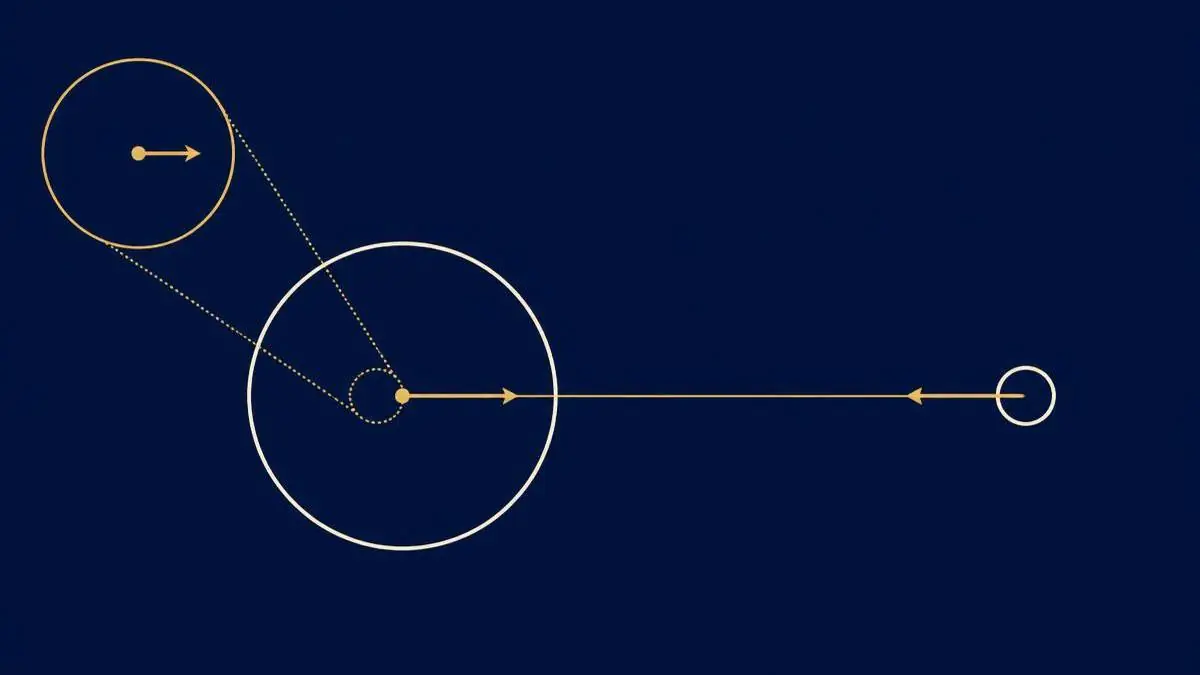
Here is the accounting. When you leave the ground you carry a certain amount of motion — physicists call it momentum, and it is just your mass multiplied by your speed. The pair of pushes has to balance, so the Earth must carry exactly the same amount of momentum in the opposite direction.
The Earth has vastly more mass than you do. Same momentum, enormous mass, so its speed must be correspondingly tiny.
Suppose you have a mass of 40 kilograms and you leave the ground at 3 metres per second. The Earth's mass is about six thousand billion billion tonnes. Run the numbers and the planet drifts away beneath you at roughly a hundred-thousandth of a billionth of a millimetre per second.
Over the half-second you are in the air, the Earth moves less than the width of a single proton. Then you land, push the other way, and hand the momentum straight back. The planet ends up exactly where it started, having gone on the shortest round trip in history.
Why the same push does such different things
The same-sized shove flings you into the air and barely troubles the Earth. That is worth sitting with, because it is the reason the world feels one-sided when it is not.
Push a shopping trolley and it rolls. Push a parked bus with identical force and you are the one who slides backwards. In both cases the pushes were equal. What differed was the mass on each end, and mass decides how much a given push actually accomplishes.
So the honest sentence is: you and the Earth push each other equally, and then you do all the moving, because moving is what light things do when heavy things push back.
What if everyone jumped at once?
There is a version of this question that goes around every school. If all eight billion people on Earth jumped at exactly the same moment, could we shift the planet?
Line everyone up shoulder to shoulder and the whole human species fits inside a large city. Add up all our mass and it comes to a few hundred million tonnes, which sounds impressive and is about a hundred-billionth of a billionth of the Earth's mass.
Do the same calculation with that combined mass and the planet drifts by something like the width of a single atom, for a fraction of a second, before every one of us lands and cancels it out. The Earth would not notice. It would not even notice if we did it all day.
And notice the deeper problem with the plan: to jump, you have to push off the Earth. You cannot move something by shoving against it, any more than you can lift yourself by pulling on your own belt. The push and the landing always cancel. That is not a limit on how strong we are; it is a limit built into how pushes work.
The version that does not cancel
Now change one thing. Instead of pushing off the Earth, throw something away from you and do not catch it.
Stand on a skateboard holding a heavy backpack and hurl the backpack forwards. You roll backwards, and you keep rolling. Nothing cancels, because you never took the momentum back.
That is not a stunt; that is precisely how every rocket that has ever flown works. A rocket throws hot gas out of its back extremely fast, and the gas pushes the rocket forward exactly as hard. Rockets do not push against the air or against the ground — which is why they work perfectly well in space, where there is nothing to push against at all.
It is also why an astronaut who drifts free of a spacecraft is in genuine trouble. There is nothing to push off. Swimming does nothing; there is no water. Their only option is to throw something — a tool, a tank of gas — and drift the other way. The tool goes one direction, the astronaut goes the other, and the sum is unchanged.
Try it in a doorway
Stand on a smooth floor in socks, feet together, holding a heavy book against your chest. Throw the book firmly forwards to somebody who is expecting it. You will feel yourself shift backwards, and if the floor is slick enough you will actually slide.
You threw a book, and the book threw you.
The idea worth keeping
Every push is a conversation, never a speech. You cannot press on the world without the world pressing back on you by precisely the same amount. The reason it usually looks one-sided is that one side of the conversation is much, much heavier than the other.
Once you start looking for the second half of every push, you find it everywhere: in a rowing boat, in a fired arrow, in the recoil of a hosepipe, in the way a cat rotates itself in mid-air by swinging its own tail. And in the fact that every time you jump, the planet — for the shortest imaginable moment — jumps too.
In the book