Why do a hammer and a feather fall at the same speed?
Heavy things do not fall faster than light things. Air is the whole reason it looks like they do.
5 min read
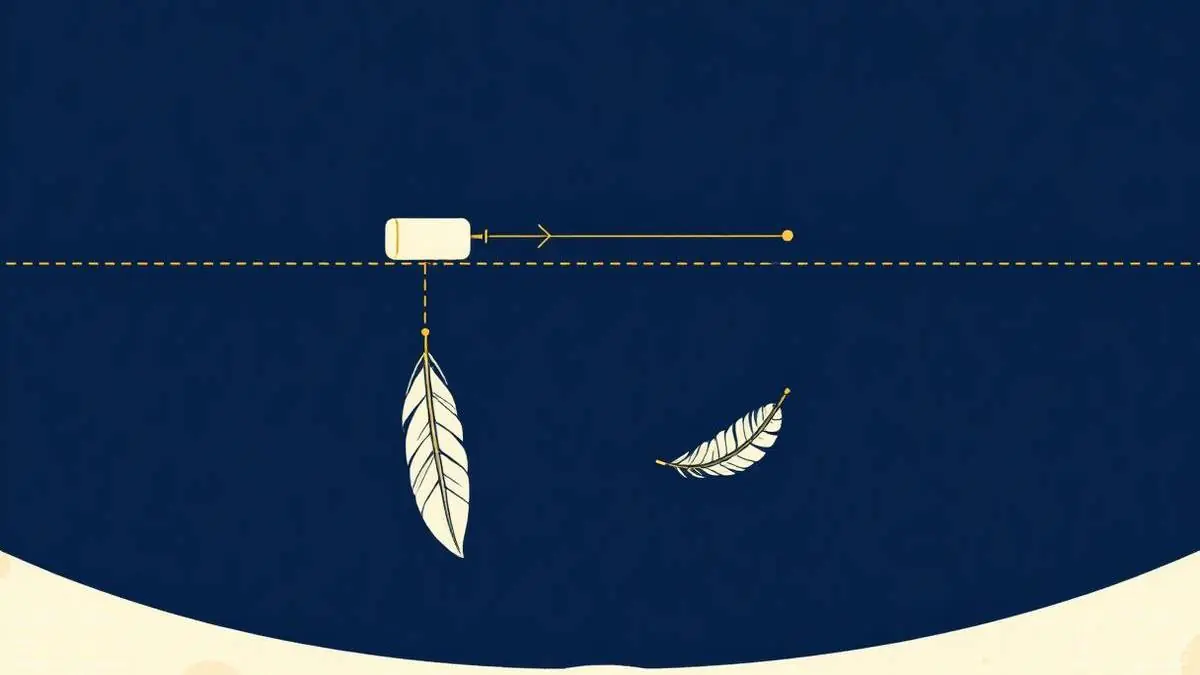
Hold a shoe in one hand and a sheet of paper in the other, lift them to the same height, and let go together. The shoe hits the floor first, and it is not close.
So heavy things fall faster. Anybody can see it. It is one of those things that is obvious, easy to test, and wrong.
The trick that ruins the obvious answer
Pick the paper up and crush it into a tight ball. Do not add anything to it. Do not remove anything. Same paper, same amount of stuff, same weight — just a different shape.
Drop them again. This time they land together, or so close that you cannot honestly call a winner.
That is the whole experiment, and it settles the question. If weight decided the race, squashing the paper would change nothing, because squashing does not change weight. Something else was slowing the flat sheet down, and it was not its lightness. It was the air.
What the air is actually doing
A falling object has to shove air out of the way, and the air shoves back. That backwards shove is called drag, and it depends on two things: how fast you are going and how much of you is facing the wind.
A flat sheet of paper presents an enormous face to the air for a very small amount of matter. It gets a lot of shove and it has almost nothing to carry that shove through, so it slows down almost immediately and then flutters gently. A crushed ball of the same paper presents a tiny face, catches hardly any shove, and drops like the shoe.
Give any falling object enough time in air and the drag grows until it exactly balances the pull downward. From then on the object stops speeding up and falls at a steady rate. That is called terminal velocity, and it is why a skydiver in a spread-eagle position falls at about 190 kilometres per hour while the same skydiver diving head-down passes 300. Same person, same weight, different amount of face.
It is also why a mouse can survive a fall that would ruin a horse. The mouse has very little mass and a relatively large surface, so its terminal velocity is slow. Its size is a parachute.
Two hundred years of arguing about it
For a very long time the accepted answer in Europe was the obvious one: heavier things fall faster, in proportion to their weight. It came from Aristotle, and it survived roughly two thousand years, mostly because nobody thought a claim that obvious needed checking.
Then, around 1590, Galileo Galilei checked. He also produced an argument so neat that you can follow it without any equipment at all.
Suppose heavy things really do fall faster. Now tie a heavy stone to a light stone with a short string and drop the pair. The light stone should hold the heavy one back, so the pair should fall slower than the heavy stone alone. But the pair together weighs more than the heavy stone alone, so it should fall faster. The same idea predicts both slower and faster, which means the idea is broken. The only way out is that they all fall at the same rate.
The famous version of the story has him dropping two balls from the Leaning Tower of Pisa. Historians are not certain that happened. What he definitely did was roll balls down gentle ramps to slow the motion enough to time it properly, and measure that everything picked up speed at the same rate regardless of weight — which is the harder, better experiment.
The version with no air at all
If air is the problem, the clean test needs a place with none, and in July 1971 one turned up.
Astronaut David Scott stood on the surface of the Moon in front of a television camera at the end of the Apollo 15 mission. In one hand he held a geology hammer. In the other he held a falcon feather. He explained what he was about to do, and let go of both at once.
They hit the dust together. You can watch the recording; the feather does not flutter, because there is nothing there for it to flutter in. It just drops, exactly as a hammer drops, only in Moon-slow motion because the Moon's pull is about a sixth of the Earth's.
Physicists have since done a tidier version in vacuum chambers on Earth, dropping a bowling ball and a feather side by side in an emptied room. It looks fake. The feather falls like a stone, because in the absence of air a feather is a stone that happens to be shaped like a feather.
Why it works out this way
There is a reason underneath all this that is worth holding on to.
Heavy things do get pulled harder. A hammer is pulled far more strongly than a feather. But heavy things are also harder to get moving — that resistance to being shoved around is called inertia, and it grows with mass at exactly the same rate the pull does.
So a hammer gets twice the pull and needs twice the pull, and the two effects cancel perfectly. Every object ends up gaining speed at the same rate: about 10 metres per second faster for every second it falls, near the Earth's surface. One second in, roughly 36 kilometres per hour. Two seconds in, roughly 72.
Nobody has ever fully explained _why_ the pull and the resistance track each other so precisely. Physicists have measured it to extraordinary accuracy, looking for the tiniest disagreement, and have never found one. It is one of the deepest facts in physics, and it is sitting right there in a crumpled sheet of paper on your kitchen floor.
In the book