Is there really a down?
Down feels like the most obvious direction there is — until you notice that it points somewhere different for everybody.
5 min read
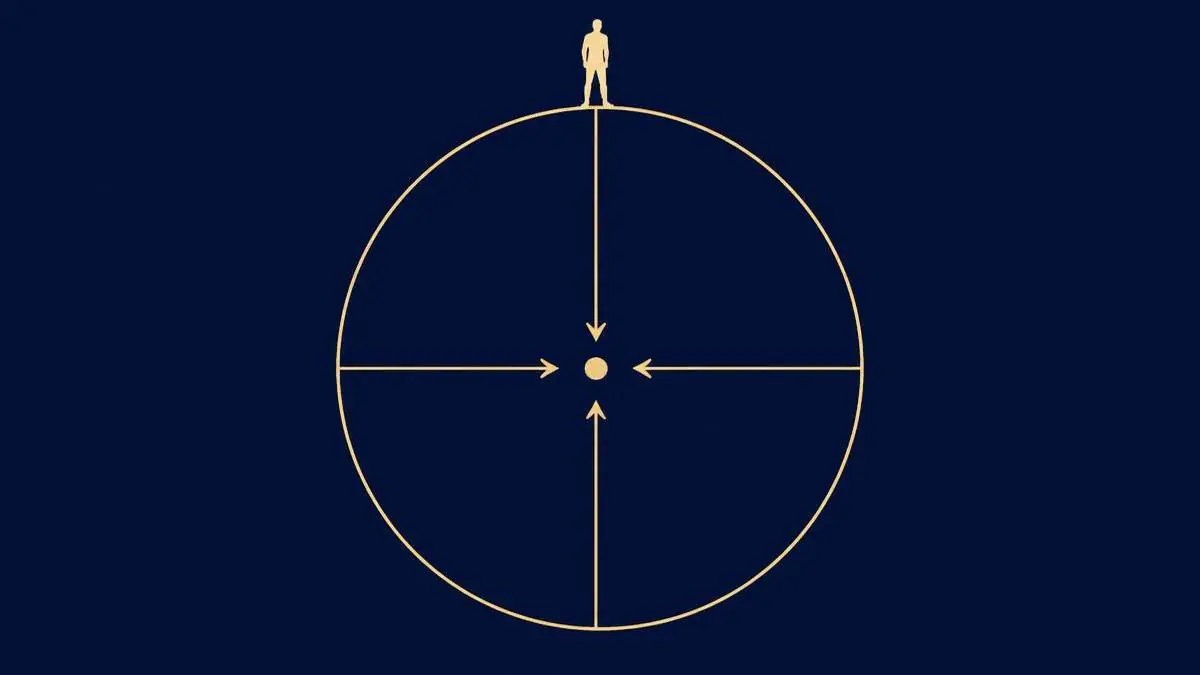
Stand up. Drop a pencil. It goes down. You did not have to think about it, and neither did the pencil.
Now find somebody who lives on the other side of the planet, and ask them to drop a pencil too. Their pencil also goes down. But if you could somehow watch both pencils at once from far out in space, you would see something strange: the two pencils are falling in opposite directions.
Both of them are right. That is the first clue that down is not one single direction stamped on the universe. Down is a local rule, and every place has its own.
Down is a name for a pull
Here is what is actually happening. Everything that has mass pulls on everything else that has mass. You pull on your pencil. Your pencil pulls on you. Your dog pulls on your sandwich and your sandwich pulls back.
You never notice any of this, because the pull is unbelievably weak unless one of the two things is enormous. And you happen to be standing on something enormous. The Earth is about six thousand billion billion tonnes, which is a number that stops meaning anything the moment you write it out. Compared to that, you are a rounding error, and so is your pencil.
So when your pencil is released, it does what everything does: it moves towards the biggest nearby pile of mass. That pile is under your feet. The pull points towards the middle of it.
That is all down is. Down means _towards the centre of the Earth_. It is not a direction in space. It is a direction relative to a particular large object, and you are standing on one.
Why every down is a different down
Because the pull points towards the centre, and because the Earth is roughly a ball, every person on the surface has their own personal down, and no two of them are quite parallel.
Walk a hundred kilometres north and your down has quietly tilted by about one degree. You will not feel it. Your body has no way to detect that your down has rotated, because your body has nothing to compare it to. Walk far enough and your down has swung all the way around to the opposite of where it started.
Nobody is upside down. There is no master arrow. If someone insists that people on the other side of the world are hanging by their feet, ask them which way the arrow is supposed to be pointing, and where it is nailed up.
The reason maps lie to you
If down is different everywhere, why does it feel so solid? Why does the idea of a bottom of the world feel so obvious that it takes effort to argue with?
Partly because your inner ear is a very good pull detector. Deep inside each ear you have tiny crystals resting on a bed of sensitive hairs. The pull tugs the crystals; the hairs report which way they were tugged; your brain labels that direction down and builds your whole sense of balance on top of it. The label is so reliable that it starts to feel like a fact about the universe rather than a reading from an instrument.
And partly because of maps. Almost every map and globe you have ever seen puts north at the top, and pictures have a top and a bottom, so north quietly became up and south quietly became down. That is a habit of printing, not a feature of the planet. A map with Australia at the top is exactly as correct as one with Norway at the top. It just looks wrong, which tells you something about you and nothing about Australia.
Somewhere with no down at all
Astronauts on a space station float, and almost everyone explains that by saying there is no gravity up there. There is. At the height of the space station the Earth's pull is only slightly weaker than it is in your kitchen.
What is missing is the floor. The station and everyone in it are falling around the planet together, at the same rate, so nothing presses against anything. The crystals in an astronaut's inner ear rest gently in the middle of their sensitive hairs and report nothing at all. No pull detected, no direction named, no down.
Astronauts describe the first few days as genuinely disorienting, then something interesting happens: they start choosing a down. They pick a wall and treat it as the floor, because working in a space with no agreed orientation is exhausting. The label is useful even when the pull is not there to supply it.
Try it yourself
Fill a bottle two-thirds with water, screw the cap on tight, and hold it still. The water finds the bottom and the surface goes flat. That flat surface is the water agreeing with your inner ear about which way is down.
Now tip the bottle. The surface stays flat and level while the bottle rotates around it. The water does not care what the bottle thinks. It is not measuring the bottle; it is measuring the pull.
Then, over something soft, toss the bottle gently upward and watch the water while it is in the air. For that half second, with nothing holding the bottle up, the surface stops being flat and the water balls up and drifts inside. That is the same effect the astronauts live in, rented for half a second in your own hallway.
The useful version
Down is not a place. Down is the direction of the nearest very large thing, measured by an instrument in your head that is honest but has no idea what it is standing on.
It is a good habit to keep. Most of the things that feel too obvious to question turn out to be measurements of something, taken from somewhere, by someone with a particular point of view.
In the book